


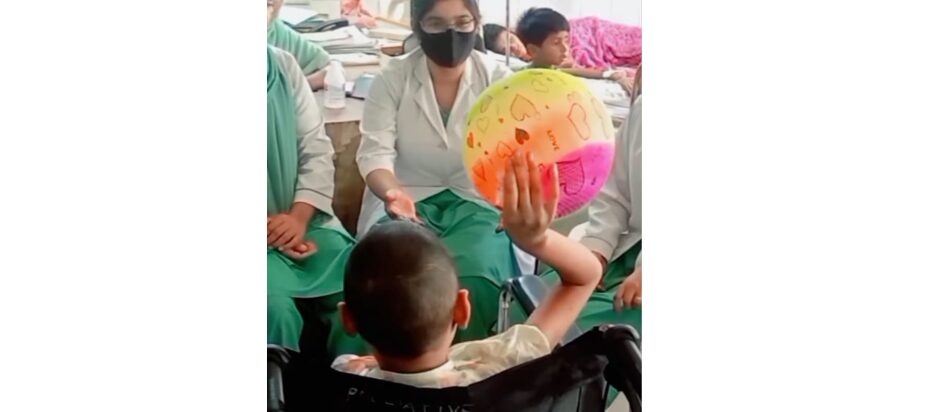
We meet most patients through their diagnoses. With her, the diagnosis was almost the least of it. She was twelve years old when I met her, living with blood cancer (relapsed acute lymphoblastic leukaemia). Her illness had already taken her strength, her independence, and nearly a year before we met, her sight. Yet whenever someone approached her bed, she turned toward them. She knew where you were standing. She smiled at the right moment. We would sometimes forget that she could not see us at all. She had learned to read the world through voices, footsteps, and the quality of someone’s presence in a room.
Adults tell themselves that ‘she is only a child, she does not understand, she will not remember’. Raisa made that impossible to believe. She understood every shift in the mood of a room. She remembered promises. She noticed when someone did not come. She waited because she felt us.
One morning we wheeled her to the middle of the ward, sat in a semicircle, and rolled a soft ball back and forth. She laughed, caught it, threw it back accurately toward our voices. The room filled with laughter. For those few minutes there was no cancer, no hospital ward. There was only a little girl playing. Play is not a distraction from suffering in a palliative setting. It is care. Play lets the child hold on to their identity when illness strips everything else away.
She never asked us for anything. When we asked what she liked, she only asked for inexpensive soft balls, so we brought her two. Later we found she loved toy kitchen sets, so we brought those too, and then a doll. Watching her turn each gift over in her hands reminded me that medicine is not the only thing that heals. Long after the injections are forgotten, children remember the people who made them smile.
Every shift I visited her before I began my work and again before I left. It became our routine. One evening I told her I would come the following night. The roster changed and I could not. When I returned the next morning and went to her bed, she burst into tears before I could say a word. She had waited through the night. I had broken a promise that mattered far more to her than I had understood. In children’s palliative care, ‘presence’ has a profound impact. For the child in that bed, it is the clinical work.
As she grew weaker, Raisa kept returning to one wish. She wanted a group photograph with all of us, something to keep beside her so that when she missed us, she could remember the people who had cared for her. A child who could not see wanted a
photograph! It did not matter that she could not look at it, it only mattered that she holds it, somehow.. Her condition worsened before we could arrange it, and I feared the moment had passed.
During a night shift, she became critically unwell. In a voice that cost her everything she had, she said, “We never took our picture.” The room went quiet. There were only a few of us on duty. We looked at each other. She loved to dress up, so we found a lipstick and an eyeliner and helped her get ready. What happened next, we will not forget. She had been barely able to speak. Now she was animated, laughing, straightening her clothes, asking if everyone was ready. We wheeled her outside and took the photograph she had been waiting for. Before we finished, she asked for one more, just of herself. Not as a ‘patient’. As a little girl.
The following day she went home. Before she left, she asked each one of us to pray for her. Her last words to me were: Please pray for me. I am suffering so much.
We could not change what happened to Raisa. But we were there, genuinely there, for the time that she had with her. We played with her, brought the small things that made her laugh, sat with her loneliness, kept our promises when we could, and at the end of one night shift helped a dying child feel like herself long enough to take a photograph.
We could not change the ending of her story. But we changed the way she lived its final chapters.


———————————————————————————————————————————————————————————————————————————-
Shahana Sharmin, Nursing Officer, Department of Palliative Medicine, Bangladesh Medical University (BMU), Dhaka, Bangladesh, and a volunteer faculty member at Sunflower Children’s Network, an initiative of Two Worlds Cancer Collaboration.