


Why did you go to Ghana? What was the purpose of the trip?
I travelled to Cape Coast, for a week in November 2024, in Ghana to teach children’s palliative care to colleagues from a nursing and medical background. These were professionals from a total of 15 different organisations, including tertiary specialist centres, local hospitals and smaller health centres. The teaching was delivered with a colleague, Alex Daniels, from the International Children’s Palliative Care Network (ICPCN), who is a nurse educator from South Africa along with Ghanian colleagues Dr Glady Dzansi and Dr Kofi.
Who did you go with?
The week-long training was part of a bigger programme, organised by ICPCN and World Child Cancer, with funding mostly from the UK government via Global Health Partnerships (formerly THET). The programme also includes virtual mentoring of Ghanaian healthcare workers, which another of our consultants, Dr Laura Nohavicka, supports. It also involves webinars, one of which will be delivered by our other consultant colleague, Dr Charlotte Holland. All the consultants at Helen and Douglas House have thus played a role in supporting the project. In addition, a number of Ghanaian colleagues came for placements in the UK, one of whom was based at HDH. Mark Azongo, a senior nurse leader from Northern Ghana, was welcomed by the care team with open arms, and even gave us a presentation on his own service. He had never seen snow, until he had the opportunity for wintery fun in the Helen House garden!
What was the highlight of your trip?
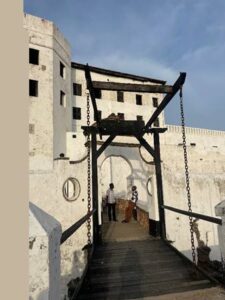
For me the highlight of any international work, is getting to know local colleagues and learning to understand the context in which they deliver care and the challenges they face. My Ghanaian colleagues had a remarkably optimistic, ‘can-do’ approach to the care they seek to improve. They had a hunger for learning and were impressive in their capacity for strategic thinking. The team from World Child Cancer, also took Alex and I to visit Cape Coast Castle, which was a real eye-opener, as it had had a very challenging history related to the slave trade in West Africa.
Who did you meet?
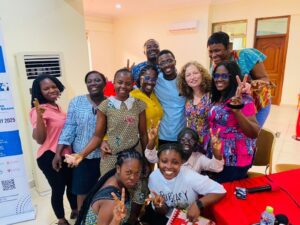
I met the local team from World Child Cancer, who were inspirational in their dedication to the training programme and made sure that everything ran well (even if it was on ‘Ghana-time’!). I also had the privilege of working with Gladys, a local professor of nursing and Kofi a local oncology specialist doctor, who practices palliative care in Ghana. The delegates were from 15 different healthcare organisations and were eager to understand how they might adapt their services to include supportive and palliative care for children. They were truly inspirational in their drive for improvement and their compassion.
What was your takeaway from the trip?
Ghana is an aspirational and forward-looking country, which was the first democracy in sub-Saharan Africa after colonial times. I felt incredibly welcome and enjoyed socialising with my local colleagues in the evenings, after training finished. The conditions from which children die in childhood are very different in West Africa. Malnutrition, malaria and HIV are still active issues and late diagnosis of cancer remains a problem in the more remote communities.
The quality of the ‘action plans’ that the delegates presented on the last day of the course was outstanding, and I genuinely believe that they will take their learning forwards.
Are future trips planned?
Our medical team (along with other UK colleagues) will continue remote support for our Ghanaian colleagues. Due to the expense and the time commitment involved, its sadly unlikely that I will be able to return there soon. I will remain an active member of the ICPCN and will continue to support international development work as much as my capacity permits. I travelled to Moldova with ICPCN in May 2023, in conjunction with Hospices of Hope, and was delighted that we were able to welcome two paediatricians from Romania to visit HDH this year, via that charity.
Is there a long-term goal from your trip?
Yes, the long-term aim is for there to be sustainable roll out of children’s palliative care, sustainably across the regions of Ghana where training was delivered. The nature of the supportive and palliative care will depend on the individual settings and the resources available, but the philosophy will hopefully be embedded. This programme is currently being formally evaluated.