


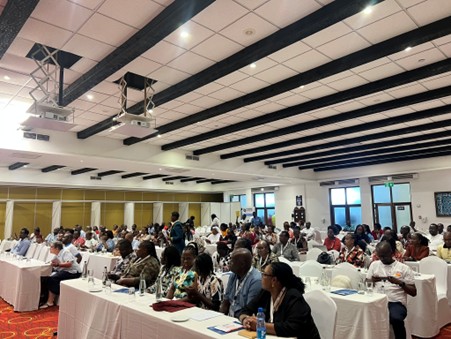
Mombasa, Kenya played host to a landmark gathering for palliative care in East Africa last month, as the Kenya Hospices and Palliative Care Association (KEHPCA), co-hosted with the Kenyan Ministry of Health, convened its 7th National Palliative Care Conference from 25–27 February 2026. Held under the theme Universal Access to Compassionate and Comprehensive Palliative Care in Kenya, the conference brought together clinicians, researchers, policymakers, and advocates united by a shared commitment to ensuring that no one faces serious illness alone, including, and especially, children.
The need is urgent. Fewer than 5% of children in Kenya who require palliative care are currently able to access it. Against that backdrop, it was deeply encouraging to see children’s palliative care woven meaningfully throughout the conference programme, not as an afterthought, but as a clear and growing priority.
For the first time, the conference featured a dedicated Paediatric Palliative Care track within the oral and poster presentations, a milestone that reflects the expanding field of children’s palliative care across Kenya and the wider region. The breadth and quality of submissions was striking. Oral presentations ranged from models of family-centred care and the power of storytelling in paediatric practice, to community-based programme evaluations, workforce mentorship, and research mapping evidence gaps and priorities for children’s palliative care in Kenya. Programmes reaching children in diverse settings, from county referral hospitals to community-based initiatives in western Kenya, were represented, painting a picture of a field that is growing in reach and sophistication. Poster presentations added further depth, including work on paediatric pain management, psychosocial support for children with sickle cell disease, and integrating children’s palliative care for universal access at the county level. The volume and variety of children’s-focused research and programme presentations sent an unmistakable signal: this is a field that is building momentum, county by county, programme by programme.

On the first day of the conference, approximately 75 clinical providers, administrators, interdisciplinary professionals, and policymakers gathered for a dedicated child-centred palliative care workshop titled Leaving No Child Behind, moderated by Dr. Beryl Okose and facilitated by Dr. Callie Daniels Howell of the International Children’s Palliative Care Network (ICPCN), Elizabeth Kabuthi, a child life specialist in Eldoret, Kenya, and Dr. Christine Marete, a paediatrician working in children’s palliative care in Embu, Kenya. The workshop created something rare and valuable: a space where multidisciplinary professionals could ask difficult questions, sit with complexity, and learn from one another across professional boundaries.
At the heart of the workshop were three hands-on skills stations, each addressing a distinct and vital dimension of children’s palliative care. Elizabeth Kabuthi led participants through child life practices and legacy building, exploring the creative, meaningful ways to support children through illness and help them leave something beautiful behind. Dr. Christine Marete facilitated a station on pharmacological and non-pharmacological pain management, equipping attendees with practical approaches to ensuring children’s comfort. Dr. Daniels-Howell facilitated a station on child- and family-centred end-of-life care, focusing on dignity, compassion, and the support that families need during a child’s final journey. Rotating through all three stations, participants left with a rounded, practical toolkit ready for use across health, community, and social service settings.
The energy across the conference reflected a movement coming into its own. Kenya’s children’s palliative care community is no longer a small, overlooked corner of a broader field; it is a community of researchers, clinicians, and advocates producing evidence, developing programmes, and asking increasingly sophisticated questions. The 7th National Palliative Care Conference made clear that the field is ready to close the gap for children, one skilled, compassionate provider at a time.
By Prof Callie Daniels-Howell, Research Manager, ICPCN
