


Authors: Gabriela García-Durán and Alex Daniels, ICPCN Education Team.
Education is fundamental to the advancement of children’s palliative care globally. However, many health and social care professionals who support children living with a life-limiting condition (LLC) or life-threatening condition (LTC) and their families lack access to practical, contextually relevant training.
To address this gap, the International Children’s Palliative Care Network (ICPCN) has released an upgraded version of its primary online course, Introduction to Children’s Palliative Care (CPC), now accessible through the ICPCN´s Education and Membership Hub.
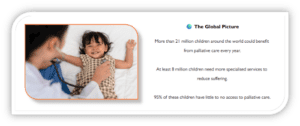
The Hub is an online platform providing professionals, caregivers, and advocates worldwide with access to education, resources, and a supportive community focused on improving care for children and families. The course is free of charge, reflecting ICPCN’s commitment to accessible education.
The upgraded course offers essential knowledge and practical tools, enabling learners to provide compassionate care in various settings, from large hospitals to rural community programs.
A Course Designed for Global Practice
This course provides a comprehensive overview of key concepts and practices in CPC. It is designed for a broad audience, including healthcare professionals, social workers, educators, spiritual carers, volunteers, students, and parents.
The following learning outcomes are central to this course, and in completion, participants should be able to:
- Define CPC and explain how it differs from adult palliative care.
- Identify which children globally may benefit from palliative care and understand the classification of life-limiting conditions.
- Describe the holistic approach to palliative care for the child and family and inherent challenges.
- Understand the role of the multidisciplinary team in delivering coordinated and compassionate care.

Participants develop practical skills and knowledge through expert-led lectures, guided readings, interactive activities, and reflective exercises, enabling immediate application in professional practice.
A personal learning journal supports participants in applying new knowledge by documenting reflections and planning for continuous improvement.
Why This Course Matters
Millions of children need palliative care, most of whom live in low and middle-income countries. However, access to services and training remains unequal worldwide.
Education helps reduce suffering by improving symptom management, strengthening teams, empowering families, and supporting the development of systems that respond to children’s needs. This course provides a clear, globally relevant learning pathway grounded in practical experience and designed to address the real-world needs of children living with an LLC or LTC and includes supporting their families.
Children require adaptable approaches tailored to their developmental stages, family situations, communication styles, and specific illnesses. These needs are often more complex than those in adult care.
 The upgraded course helps learners understand these differences clearly and thoughtfully, covering topics such as:
- The principles and philosophy of CPC.
- The central role of families and evolving decision-making.
- Differences between CPC and adult palliative care.
- Models of care delivery across diverse contexts.
The course highlights multidisciplinary teamwork across physical, emotional, social, and spiritual domains. Each topic includes opportunities for reflection and practical application, encouraging learners to integrate new knowledge into their daily work.
Designed for Reflection, Not Just Completion
Reflective learning is a central component of the updated course. Participants analyze case examples, compare service models, and use a personal journal to document their insights.
The course offers participants opportunities to develop and refine their skills through reflection, self-awareness, and the compassionate management of uncertainty. Interactive exercises help integrate theory and practice across diverse settings, including hospitals and family homes, and among healthcare professionals, social workers, spiritual carers, educators, volunteers, parents, and students.
Through comparative activities, learners examine how children’s palliative care is organized worldwide and consider how partnerships, resources, and cultural factors influence care in their own communities.
Multilingual resources, including the ICPCN Charter, highlight the course’s focus on accessibility and advocacy, motivating learners to become agents of change.
Strengthening Teams, Supporting Families, Shaping Systems
CPC is built on strong relationships, effective teamwork, clear communication, and trust with families during challenging times. emphasizes the significance of teamwork, clearly defined roles, effective communication, and psychological safety for professionals operating in emotionally demanding environments.
Learners reflect on their roles in delivering holistic care and explore strategies for effective collaboration across different settings and services. The course encourages a shift from viewing palliative care solely as a treatment phase to recognizing it as a comprehensive philosophy that supports children from diagnosis onward.
 Where disparities in care persist, education can transform professional practice, support advocacy, and build communities dedicated to culturally relevant, compassionate, equitable care.
The upgraded Introduction to CPC course encourages participants to engage in learning, reflection, and leadership within their communities.
When knowledge is integrated with compassion, care is not only possible but also transformative.
Registration is now open through the ICPCN´s Education and Membership Hub. Enroll in this free course to expand your knowledge, connect with a global community, and contribute to advancements in CPC. The new course is currently available in English, and plans are underway to translate it into additional languages.
Contact:
📸 Image Use and Copyright Statement
All images used in the Introduction to Children’s Palliative Care course are sourced from 123RF.com and are used under a valid paid licence. The use of these images comply with copyright and intellectual property regulations.